


akaco mug
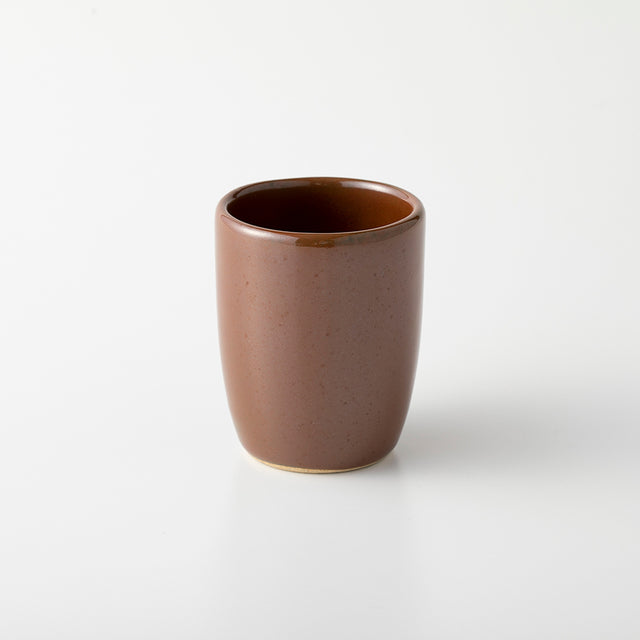
Persimmon glaze is characterized not only by its unique color but also by its high heat retention properties due to the high iron content in the glaze.
- A mug typical of Mashiko ware -
The ``akaco mug'' is shaped like an old Mashiko ware cup with a handle attached. The inside is coated with a transparent white glaze.
If the handle is too small, it will be difficult to hold, and if it is too large, the center of gravity will be unbalanced, which will greatly affect the impression and quality of the mug.
At Sayado Wadagama, the handles of the mugs are attached by hand by craftsmen, so each handle is slightly different in shape.
Just as people's fingers are shaped differently, so too are the shapes of the handles.
― “Persimmon glaze”, a glaze representative of Mashiko ware ―
Persimmon glaze is a special glaze that represents Mashiko ware in Mashiko.
Many people may think of the color of persimmon glaze when they think of Mashiko ware.
Mashiko Town has developed as a pottery production area since the end of the Edo period.
Later, Mr. Shoji Hamada moved to Japan, and while promoting the Mingei movement with Mr. Soetsu Yanagi and others who focused on the ``beauty of use'', it had a great influence on local potters, and began to be regarded as a ``work of art.'' Masu.
Persimmon glaze is also a glaze that was often used for utensils such as bowls, water bottles, and earthenware jars that represent the early days of Mashiko ware.
The ``akaco'' series is a series that explores the expression of persimmon glaze and vessels that fit in with modern life.
- Red powder that is the raw material for persimmon glaze -
The raw material for persimmon glaze is Ashinuma stone from the northern region of Mashiko Town. The powdered form of Ashinuma stone is called red powder and is used as a glaze. Since persimmon glaze is made entirely from natural materials, it does not contain any chemical substances.
In addition, persimmon glaze contains iron and retains heat. Mashiko red powder has long been used for roof tiles in the Tohoku region.
■Size approximately: 11.0cm x 7.0cm x 9.0cm
(Length including handle x rim x height)
■Capacity: approx. 200ml *Capacity when full
Specifications & Care
- Material
- Pottery
- Origin
- Mashiko, Tochigi, Japan
- Microwave
- Microwave safe
- Dishwasher
- Dishwasher safe, but we recommend washing by hand
- Oven / Open flame / Toaster oven
- Not suitable
Before first use (sealing)
About dishwashers
Oven, open flame and toaster oven
Daily care
Crazing (kannyu) and how the piece matures
Individual differences
Repairs
Please check before purchasing.
Each pottery of Sayado Wadagama is made by hand. The appearance of the pottery changes depending on the natural environment in which it is made and the environment in which it is fired, and no two pottery are the same. Before purchasing, we ask for your understanding and understanding regarding the expression and individual differences of the vessels.


About gift wrapping
Every item you purchase will be gift-wrapped starting from 1 piece.
You can also use Noshi. If you would like it, please select the wrapping link on the purchase page and add it to your cart.

道祖土和田窯のうつわあわせ
「この器、家だったらどう使おう?」
そんな会話からうまれた、うつわの楽しみ方いろいろ。
いつものごはんがちょっと楽しみになるような、
そんな器との暮らしをご紹介しています。
How about this vessel?


他の器をさがす


What is Sayado Wadagama?

About Sayado Wadagama
Sayado Wadagama is written as ``Sayado Wadagama.''
SAYADO is a place name in Mashiko Town. This area, which has long produced clay for pottery, is the center of Mashiko ware production, as it produces clay, the raw material for Mashiko ware, and is home to many Mashiko ware kilns.
Sayado Wadagama is a brand that aims to produce pottery, which can be said to be a product of nature, with a ``responsibility of receiving from nature'' and to deliver the charm of pottery to as many people as possible.
Through the tools of pottery, we provide true abundance and help people and the earth coexist.
Aiming for such a future, we continue to face the soil today.


